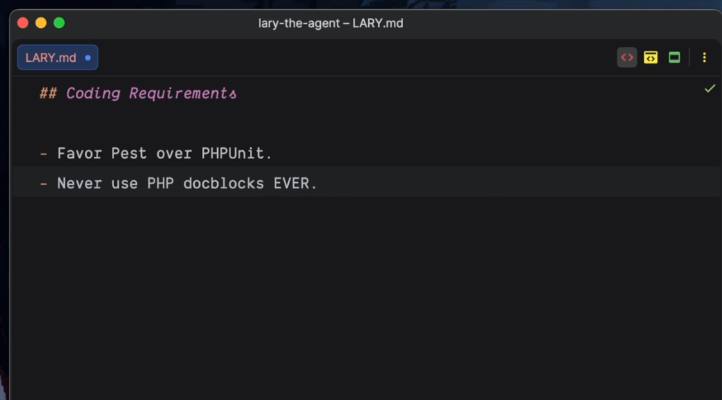
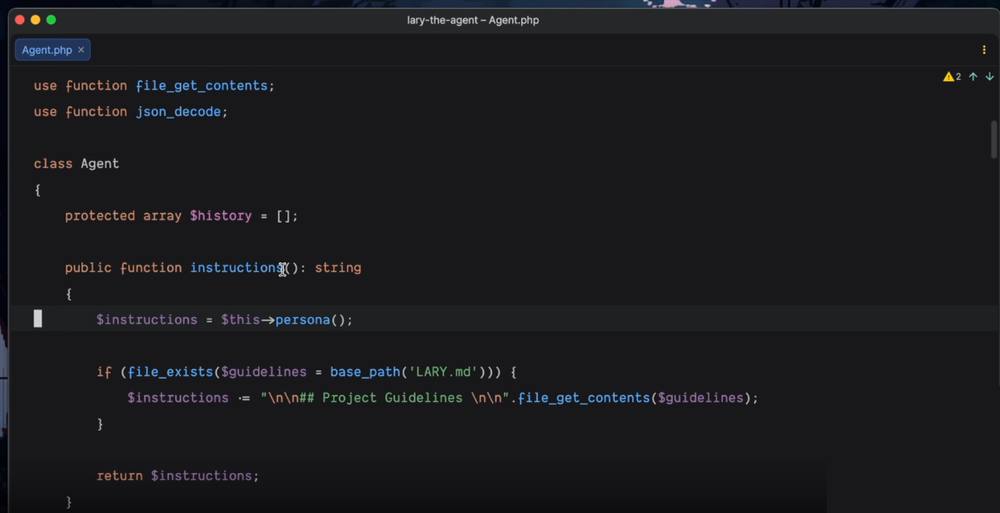
Generate a Pest test, replace its contents, then run it. The second test keeps a backup of your real LEO.md while it runs.
Run
php artisan make:test AgentTest --pest
Replace file · tests/Feature/AgentTest.php
<?php
use App\Ai\Agents\Agent;
test('it prepares the agent instructions', function () {
expect((new Agent)->instructions())->toStartWith('You are a helpful AI assistant.');
});
test('it optionally loads LEO.md guidelines', function () {
$path = base_path('LEO.md');
$original = @file_get_contents($path); // keep your real file safe
$guidelines = '- Use Pest instead of PHPUnit.';
file_put_contents($path, $guidelines);
expect((new Agent)->instructions())
->toContain('## Project Guidelines')
->toContain($guidelines);
$original === false ? @unlink($path) : file_put_contents($path, $original);
});
Run
php artisan test --filter=AgentTest
Replace file · app/Ai/Agents/Agent.php
<?php
namespace App\Ai\Agents;
use App\Ai\Attributes\CompactsAfter;
use App\Ai\Tools\Tool;
use Illuminate\Support\Facades\Http;
use ReflectionClass;
use function Laravel\Prompts\info;
class Agent
{
/** The conversation so far: everything we send back to the AI each time. */
protected array $history = [];
// ---------------------------------------------------------------
// Things a child agent can override
// ---------------------------------------------------------------
/** Who the agent is. Override this in a child class. */
public function persona(): string
{
return 'You are a helpful AI assistant.';
}
/** The tools this agent may call. */
public function tools(): array
{
return [];
}
/** Optional JSON schema the final answer must match (structured output). */
public function schema(): array
{
return [];
}
// ---------------------------------------------------------------
// Instructions = persona + LEO.md guidelines
// ---------------------------------------------------------------
public function instructions(): string
{
    $instructions = $this->persona();

    if (file_exists($guidelines = base_path('LEO.md'))) {
        $instructions .= "\n\n## Project Guidelines\n\n".file_get_contents($guidelines);
    }

    return $instructions;
}
public function messages(): array
{
return $this->history;
}
// ---------------------------------------------------------------
// The agent loop
// ---------------------------------------------------------------
public function prompt(string $prompt): string
{
$this->maybeCompact();
$this->history[] = ['role' => 'user', 'content' => $prompt];
// The inner loop: the agent's "inner dialogue".
while (true) {
$response = $this->runModel();
// Record everything the AI said, including any tool requests.
$this->history = [...$this->history, ...$response['output']];
$toolCalls = collect($response['output'])
->filter(fn (array $item) => $item['type'] === 'function_call');
// No tools requested? Then this is the final answer.
if ($toolCalls->isEmpty()) {
return static::text($response);
}
$toolCalls->each(fn (array $call) => $this->runTool($call));
}
}
protected function runTool(array $call): void
{
if (app()->runningInConsole()) {
info("Running tool: {$call['name']}({$call['arguments']})");
}
$tool = collect($this->tools())
->first(fn (Tool $tool) => $tool->definition()['name'] === $call['name']);
$output = $tool
? $tool->use(json_decode($call['arguments'], associative: true) ?? [])
: "Error: unknown tool {$call['name']}";
// Send the result back, linked to the request by its call_id.
$this->history[] = [
'type' => 'function_call_output',
'call_id' => $call['call_id'],
'output' => (string) $output,
];
}
protected function runModel(): array
{
$payload = [
'model' => config('services.openai.model'),
'instructions' => $this->instructions(),
'input' => $this->history,
];
if ($this->tools()) {
$payload['tools'] = array_map(fn (Tool $tool) => $tool->definition(), $this->tools());
}
// Only ask for structured output when the agent defines a schema.
if ($this->schema()) {
$payload['text'] = [
'format' => [
'type' => 'json_schema',
'name' => 'assistant_response',
'strict' => true,
'schema' => $this->schema(),
],
];
}
return Http::withToken(config('services.openai.key'))
->timeout(120)
->post('https://api.openai.com/v1/responses', $payload)
->throw()
->json();
}
/**
* Pull every piece of text out of a response.
* Safer than $response['output'][0]['content'][0]['text'],
* because the first output item is not always a message.
*/
public static function text(array $response): string
{
return collect($response['output'] ?? [])
->where('type', 'message')
->flatMap(fn (array $message) => $message['content'] ?? [])
->where('type', 'output_text')
->pluck('text')
->implode("\n");
}
// ---------------------------------------------------------------
// Compacting: summarise long conversations
// ---------------------------------------------------------------
protected function maybeCompact(): void
{
if ($this->shouldCompact()) {
$this->compact();
}
}
protected function shouldCompact(): bool
{
return $this->threshold() < count($this->history);
}
protected function threshold(): int
{
$attributes = (new ReflectionClass($this))->getAttributes(CompactsAfter::class);
return $attributes ? $attributes[0]->newInstance()->threshold : 30;
}
protected function compact(): void
{
$response = Http::withToken(config('services.openai.key'))
->timeout(120)
->post('https://api.openai.com/v1/responses', [
'model' => config('services.openai.model'),
'instructions' => 'Summarize the following conversation history concisely. '
.'Preserve key facts, decisions, tool results and unresolved questions. '
.'Omit pleasantries and redundant exchanges.',
// Sent as one block of JSON text, so tool calls in the history can't confuse the API.
'input' => [
['role' => 'user', 'content' => json_encode($this->history, JSON_PRETTY_PRINT)],
],
])
->throw()
->json();
$this->history = [
['role' => 'user', 'content' => "[Earlier Conversation Summary]\n\n".static::text($response)],
];
}
}
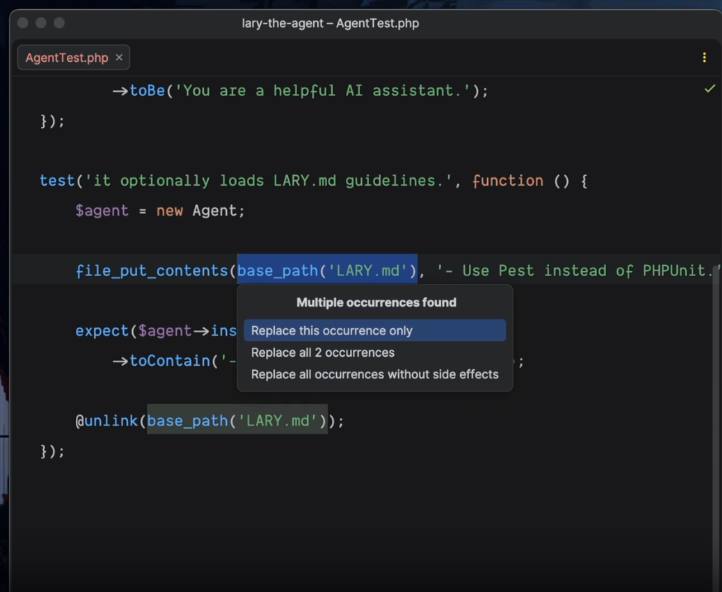
A Pest test for the optional guidelines file.