Replace the file with this. Read it in this order: the outer while, the inner while, finding function calls, running them, adding the outputs, and going round again.
Replace file · app/Console/Commands/AgentCommand.php
<?php

namespace App\Console\Commands;

use Illuminate\Console\Command;
use Illuminate\Support\Facades\Http;

use function Laravel\Prompts\info;
use function Laravel\Prompts\spin;
use function Laravel\Prompts\text;

// Lesson 3: an outer loop (you) and an inner loop (the agent using tools).
class AgentCommand extends Command
{
    protected $signature = 'agent';

    protected $description = 'Chat with an agent that can use tools';

    protected array $history = [];

    public function handle(): void
    {
        // OUTER loop: your conversation with the agent.
        while (true) {
            $prompt = text('What is on your mind?', required: true);

            $this->history[] = ['role' => 'user', 'content' => $prompt];

            // INNER loop: the agent keeps going until it has an answer.
            while (true) {
                $response = spin(fn () => $this->runModel(), 'Hmm... thinking about that.');

                $this->history = [...$this->history, ...$response['output']];

                // Find every tool the AI wants us to run (there can be several).
                $functionCalls = collect($response['output'])
                    ->filter(fn ($item) => $item['type'] === 'function_call');

                // None? Then the AI has its final answer.
                if ($functionCalls->isEmpty()) {
                    info($this->outputText($response));
                    break;
                }

                $functionCalls->each(function (array $call) {
                    info("Running tool: {$call['name']}");

                    $output = match ($call['name']) {
                        'get_current_time' => now()->toIso8601String(),
                        'read_file' => file_get_contents(
                            base_path(json_decode($call['arguments'])->path)
                        ),
                        default => "Error: unknown tool {$call['name']}",
                    };

                    // Send the result back, matched to the request by call_id.
                    $this->history[] = [
                        'type' => 'function_call_output',
                        'call_id' => $call['call_id'],
                        'output' => (string) $output,
                    ];
                });
            }
        }
    }

    protected function runModel(): array
    {
        return Http::withToken(config('services.openai.key'))
            ->post('https://api.openai.com/v1/responses', [
                'model' => config('services.openai.model'),
                'instructions' => 'You are a helpful assistant.',
                'input' => $this->history,
                'tools' => [
                    [
                        'type' => 'function',
                        'name' => 'get_current_time',
                        'description' => 'Get the current server time as an ISO 8601 string.',
                    ],
                    [
                        'type' => 'function',
                        'name' => 'read_file',
                        'description' => 'Read the contents of a file, relative to the project root.',
                        'parameters' => [
                            'type' => 'object',
                            'properties' => [
                                'path' => ['type' => 'string', 'description' => 'The relative path to the file.'],
                            ],
                            'required' => ['path'],
                            'additionalProperties' => false,
                        ],
                        'strict' => true,
                    ],
                ],
            ])
            ->throw()
            ->json();
    }

    // The first output item is not always a message (it can be a tool call),
    // so collect the text from every message item instead of using [0].
    protected function outputText(array $response): string
    {
        return collect($response['output'])
            ->where('type', 'message')
            ->flatMap(fn ($message) => $message['content'])
            ->where('type', 'output_text')
            ->pluck('text')
            ->implode("\n");
    }
}
The small outputText() helper replaces output[0].content[0].text. Once tools are involved, the first output item is often a function call rather than a message.
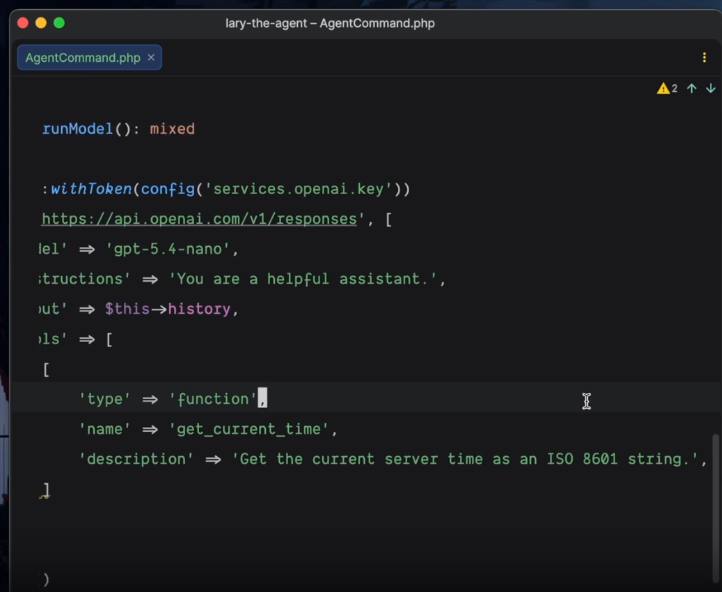
Adding a tools array to the request: get_current_time.
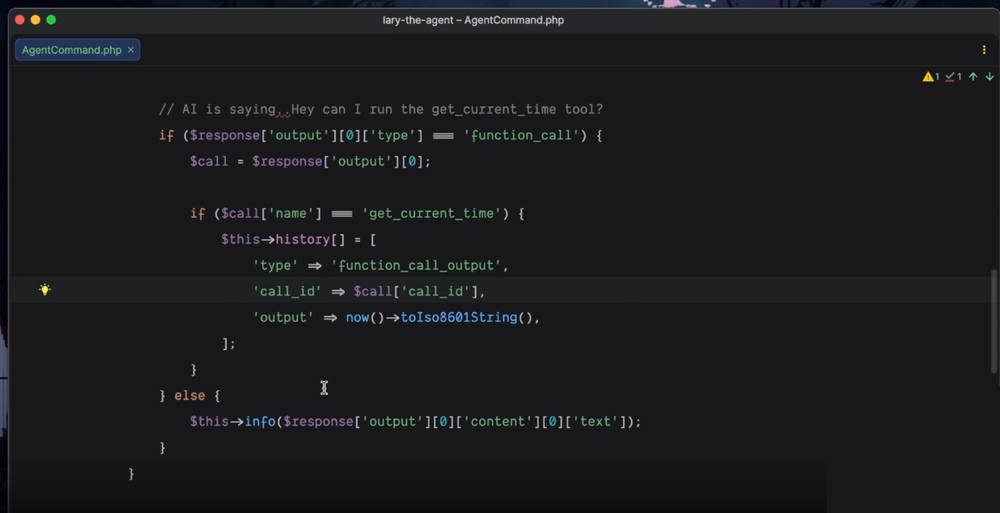
Answering a tool call with a function_call_output and its call_id.
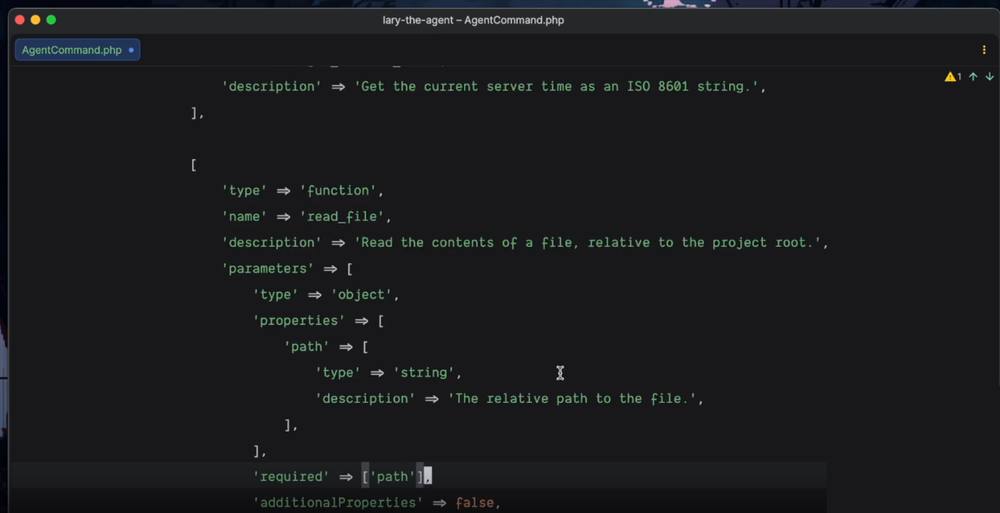
A tool with parameters: read_file takes a path.
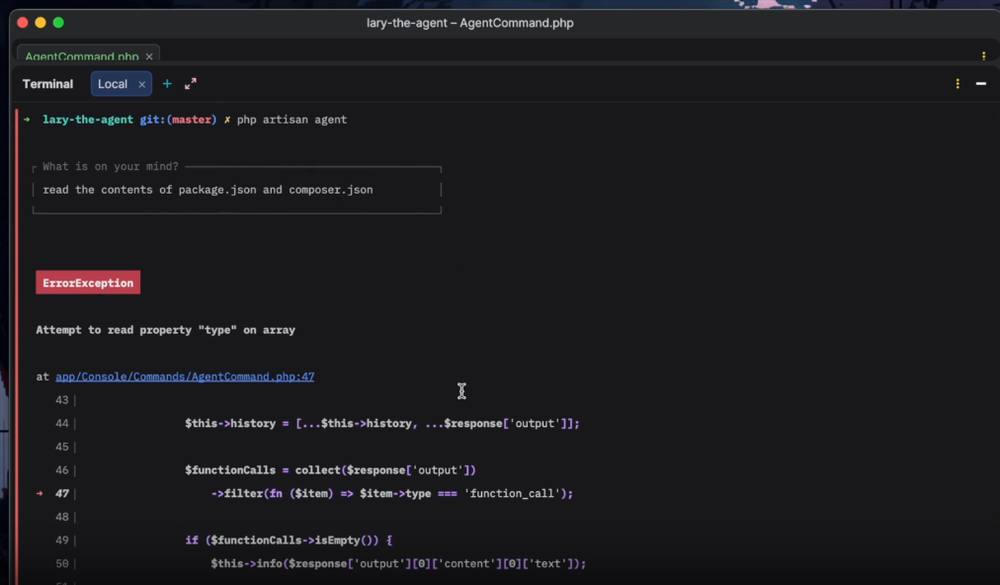
Collecting every function_call with collect()->filter().